Gianni Schicchi
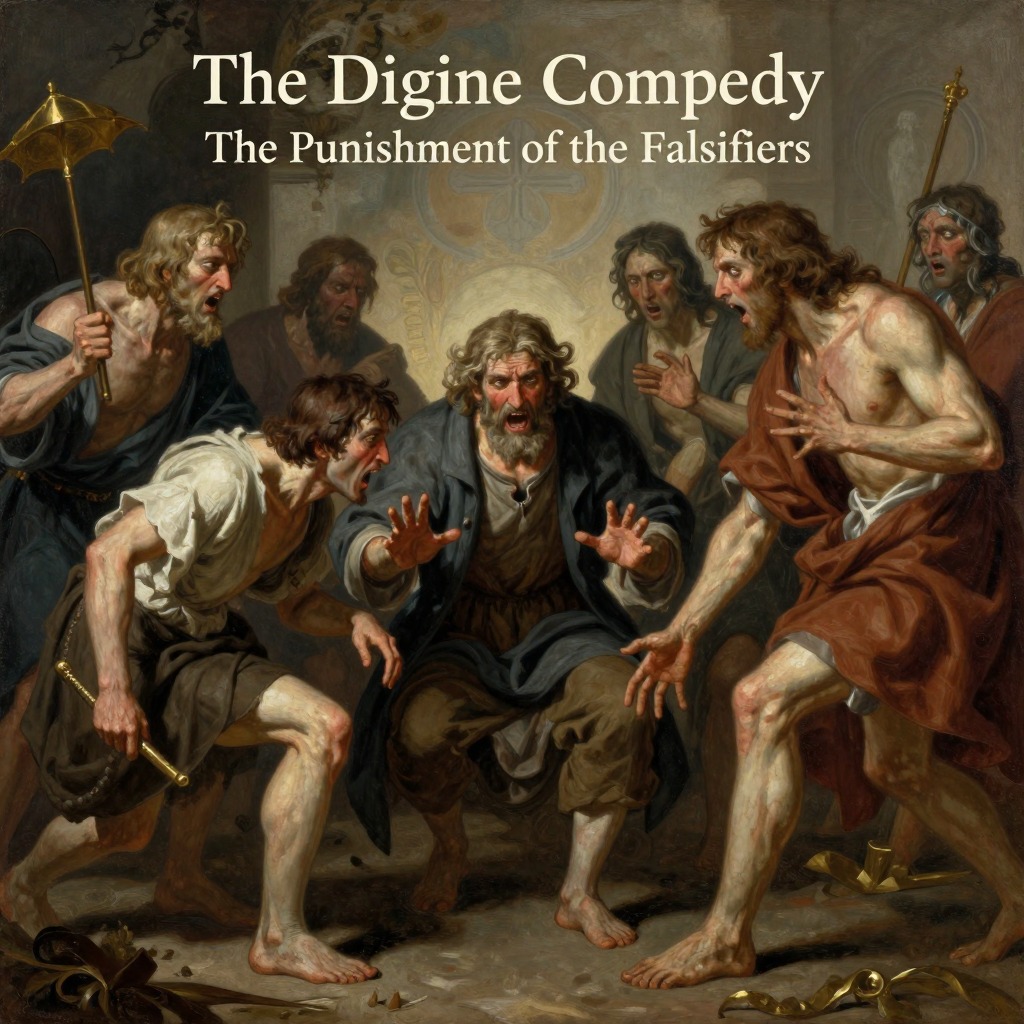
Gianni Schicchi appears in the Tenth Bolgia of Malebolge, the circle of the Falsifiers, where he is condemned for the sin of impersonation—a form of falsification that corrupts identity and trust. His punishment reflects the contrapasso of his crime: just as he assumed another's form to deceive, he is now reduced to a raving, animalistic state, his humanity stripped away. In the narrative, he is introduced as a "mad sprite" who, along with the ancient ghost of Myrrha, runs biting through the circle, attacking the alchemist Capocchio by seizing his neck with his teeth and dragging him so that his belly grates the solid bottom. This violent, irrational behavior marks Schicchi as one of the most degraded figures in the Inferno, his punishment a literal enactment of the bestiality into which his fraudulent act has transformed him.
Identity and Background
Gianni Schicchi was a real historical figure from Florence, a member of the Cavalcanti family, who lived in the late 13th century. He is infamous for a specific act of fraud: after the death of Buoso Donati, a wealthy Florentine, Schicchi impersonated the dead man in his bed, dictating a false will that bequeathed a substantial portion of the estate—including a prized mare, the "lady of the herd"—to himself. This crime, a blend of forgery and theft, is the sole reason for his damnation. In the Inferno, he is grouped with other Falsifiers, including the counterfeit coiners and perjurers, but his particular offense—theft of identity—sets him apart as a figure whose sin directly attacks the integrity of personal and legal identity.
Punishment and Contrapasso
Schicchi's punishment in the Tenth Bolgia is a vivid instance of Dante's contrapasso. The Falsifiers are afflicted with loathsome diseases and madness, and Schicchi's specific torment is a form of rabies: he runs through the circle biting and rending other sinners, as if possessed by a demonic fury. The text describes him as a "mad sprite" who "raving goes thus harrying other people," his actions mirroring the way he once "counterfeited in himself Buoso Donati" to seize property. His loss of human reason and speech—he communicates only through violent, animalistic attacks—reflects the way his crime erased the boundary between self and other, reducing him to a creature of pure appetite. The other sinner, Capocchio, identifies Schicchi by name, confirming that his infamy has followed him into Hell.
Narrative Role and Significance
Schicchi's brief but memorable appearance serves several functions in the Inferno. First, he exemplifies the gravity of fraud against personal identity, a sin that Dante places among the most serious in Malebolge. Second, his raving madness contrasts with the more articulate suffering of other Falsifiers, such as Master Adam and Sinon, whose verbal disputes highlight the intellectual corruption of their sins. Schicchi's silence and bestiality underscore the dehumanizing effect of his crime. Finally, his story—along with that of Myrrha, who also impersonated another to commit incest—illustrates the theme of counterfeit identity as a perversion of God-given individuality. In the broader structure of the Comedy, Schicchi stands as a warning against the abuse of trust and the theft of another's name, a sin that Dante, as an exile who valued his own name above all, would have found particularly heinous.